Saturday, January 5, 2013

Mudjar Rug - progress


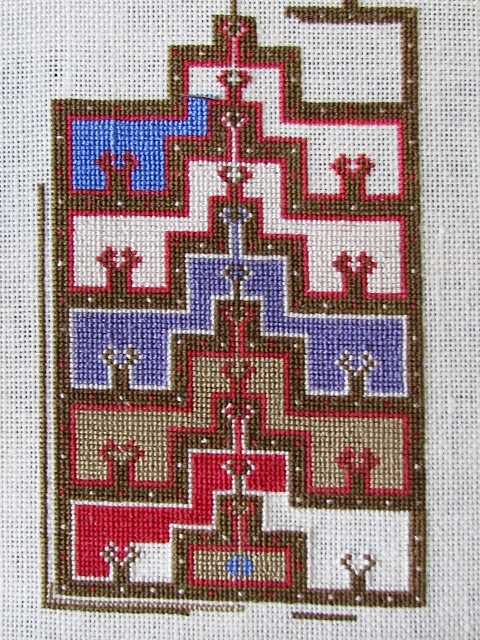
As Mr. Cooper indicates in his text alongside his miniature (see previous post today), the series of prayer arches in this rug is very rare to find.  Also what is rare is the selection of colours, unusual for the rugs worked in this area of Turkey in the early 1800's.

I am making quick progress. One would think that I am solely focused on this project right now.   Not so.  In fact, next week I begin teaching again. It will be a small class of 6 students over 6 weeks where I shall initiate them into the art of needlepainting.  Preparations for the class along with the projects which will comprise the practice elements in the course are well underway.  


The Mudjar Carpet


The miniature carpets which Frank M. Cooper has prepared charts for have really captured my attention recently.  No sooner had I finished my interpretation of the Berlin Rug, I was ready to start another detailed piece.      The picture to the left is Mr. Cooper's rendition of the original design of a Mudjar prayer rug.  The original dates to the first part of the 19th century and measures roughly 42 x 60  inches.   Mr. Cooper's interpretation is executed in wool on canvas.   His final piece measures approximately 9 x 13 inches.  Once again, I shall work on a smaller gauge linen with Pearsall's silks.   The final dimensions will be 5 1/2 x 8 1/2 inches.

Sunday, December 16, 2012

The Berlin Rug - interpretation


The Berlin Rug fragment

Silk on linen (28 ct) foundation,  1568  movements per square inch. Dimensions of the embroidery 4,75 x 8,5 ins (11,875 x 21,25 cms); embroidered by Kathryn Blackmore Borel, L’Art de l’Aiguille, Canada, 2012

This piece took me through all seasons, beginning in late Spring with the last of the snow on the garden and finishing in early winter as the first snow arrives.  At no time did I tire of this densely-stitched piece.  The colours were clean, the lines defined precisely.  There were rest periods where I could just stitch without referring to a chart, and other times where each movement had to be measured and counted.

It took an estimated 120 hours through close to 6 months of 2012 and  more than 60,000 movements of the needle through the fabric.  The eye concentrates on the precision of each stitch but the mind, at times, wanders and settles elsewhere.  The therapeutic aspect to this creative exercise allows ideas to find order where chaos reigned previously.  It is as if the thread gives linearity to jumbled thoughts and fixes them into a relative perspective.  It is regenerative as if I have eaten a nourishing meal where I might have been hungry;  food for the mind.  


The time I spent on this piece made me mull many of the fundamental questions I have.  What is original? What is a copy?  What defines ‘art’? Where does embroidery as a creative expression find itself in the ‘art’ world?  Is it part of the higher arts?  Is it a decorative art?  Is it not art at all but ‘craft’?   What is the vocabulary appropriate for this discipline?    What are the influences, the evolution, the social significance, the iconography.  What is the role of textile and specifically embroidery in our world?   

I often think that there is little artistry in a counted-thread work.  The art is in the preparation of the chart.  So full credit goes to Frank Cooper and a chart I discovered in his book ‘Miniature Carpets’.  To interpret the design, I chose different materials, working on a scale almost half as small as his design, using a lightly twisted silk thread rather than wool on a linen ground fabric as opposed to a cotton canvas.  As I worked, I felt less and less as if I was copying since what was jumping off the fabric was a work that had its own character, its own particular beauty, its own  specificity. 

I kept a photograph of the 15th century carpet fragment in my vista while I worked.  It was a reminder that there is very little original under the sun and most creative works are the result of an influence, conscious or subliminal, of something already seen and experienced.   Between this original piece and my work, there are only two degrees of separation;  Mr. Cooper's preparation of a chart and my interpretation of it.  But I did not copy the chart to the letter.  Aside from the adjustment in materials, I chose to not finish the right side, leaving the piece intentionally incomplete  The goal was to acknowledge that what remains of the original carpet is just a portion of it, and in so doing to broaden the conversation around my interpretation.

My fragment sits on my work table waiting for framing.  I love it.  I actually marvel at its simplicity and its beauty.  It envelops so many of the elements I hold dear:  pure fibre, clean lines, meaningful iconography, lustrous colour, small proportions.  It was an adventure into a far past which enriched much of my studio time in 2012, both intellectually and creatively, and, more importantly, while it lives alongside me, it will impart that essence of beauty which I crave daily.


Thursday, July 19, 2012

The Berlin Rug

http://en.wikipedia.org/wiki/File:Phoenix_and_dragon_carpet_Anatolia_first_half_or_middle_15th_century.jpg

The link above gives the history of the piece which inspired the following work.  The chart from which I am working is included in  Frank M. Cooper's book on 'Oriental Carpets in Miniature'.  I'm tempted to leave my work incomplete and give it some additional significance recognizing that it is a copy of a fragment of the original carpet dating back to the 15th century also, understandably, incomplete.  I am not yet decided on this idea.  Here is my progress.


I am using Pearsalls Silks, rich blue, red, off white and golden yellow.  The silk gives a lusciousness to the work, and the light reflected by this pure fibre is of great clarity.  No room for error on this piece since the silk sits so exactly, if there is a change in tension, or incorrect placing of the needle, it will be visible.

Wednesday, April 25, 2012

Iris - progress 1

We've been travelling for the last couple of weeks, so there was no time to be in the studio.  


We were in France.  The first couple of days were spent in Normandy, in Bayeux and I finally had the chance to wander through the Museum to view 'La Tapisserie de la Reine Mathilde', after all these years during which I have frequently studied the pages of David Wilson's magnificent book on the story related in this 1000 year old embroidery.


The last week was spent in Paris, with family,  a reunion of sorts with the focus of a posthumous celebration for my father-in-law, whose courageous work during difficult times during the war was recognized and honoured.


We returned to the forest last Wednesday and I quickly organized myself to start work on the iris.   It's not that easy and I'm not sure yet about the effect of my work, but I am enjoying the experimentation with various types of silk thread, Pearsalls, Pipers and some chinese silk, Eterna.


This project is also a departure from my usual style given that it is so dense in its design.  Usually I work on simple lines and single subjects suspended on the linen.  I am having difficulty seeing the final picture in my mind despite the fact that I have done a watercolour study and thought a lot about the technical interpretation.   I am however enjoying the freedom of letting the colours and the various silks take me where they seem to want to go.  The result will surprise me;  hopefully in a good way.


Friday, March 23, 2012

Iris - a study


I took this picture last summer.. the colours were magnificent and thoroughly inspiring for a study in embroidery.


To do a first analysis, I took out my watercolour pencils and began experimenting.  In order to render a visual image in thread, I have to simplify it without sacrificing any of its pristine beauty.  Although I can't get much density in the colouring,  just fiddling around with the pencils and merging with water, I had a better understanding as to how I would tackle the subject with silk thread.


So here is the first throw with the coloured pencils.  I had difficulty deepening the colours.  Although I was working on a 140 lb paper, I was concerned that more water would break up the fibres and take away some of the clarity I was looking for.  It is a little like working a silk thread too much, it breaks up and loses the luminosity.  


But the exercise was invaluable.  I was able to remove some of the busy background and single out what I think is worthy of embroidering.  However,  I already anticipate some difficulty interpreting the leaves and the earth... 


Next step is to transfer the drawing to linen and choose the palette of colours.    Stay posted for progress.

Saturday, March 3, 2012

William Morris - The Hare


Beth Russell has developed some beautiful charts inspired by William Morris.  Here is 'The Hare Pillow', photographed with two other designs which I have shown in earlier posts.