It's taken me over a year for this piece too (check the post on March 3, 2012). I finished it this morning. It was a snowy day outside, so I stayed in front of the fire with my coffee and put in the last of the background stitching.
Beth Russell created a fine design and I had immense pleasure stitching this. Her original design called for petit point in wool on a large count canvas. As is my usual habit, I worked on a 28 count linen with one thread of cotton embroidery floss. The final piece measures 16 x 16 cms.
My hare already has a home to go to. I just have to frame it before it leaps away.
Sunday, February 24, 2013
Tuesday, February 19, 2013
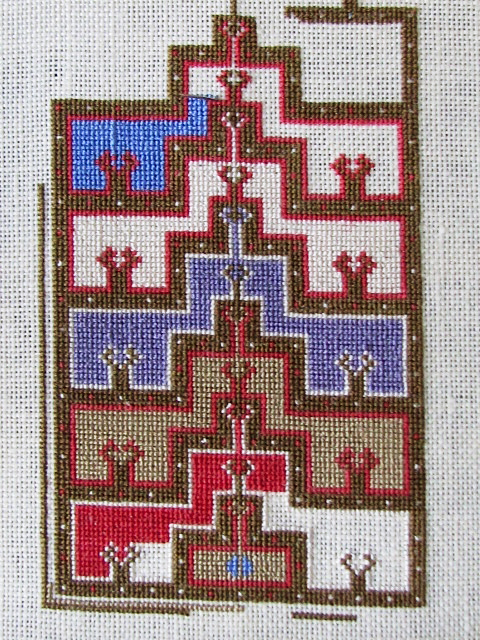
Mudjar Rug - progress
I began this project very quickly after finishing the Berlin Rug Fragment. I was drawn by the unusually modern colour palette despite the age of the original piece which dates back to the beginning of the 19 th century, and the distinctive design of the prayer arches.
I work on it regularly although I have three or four other projects on the go simultaneously right now. Since the threads I am using are the Pearsall's silks, it is a joy after working with a finer flat silk on a complicated needlepainting project to sit with this piece. As with most cross stitch works, it is restful to follow a pattern rather than analyse one's every move which is the case with needlepainting. At left is the photo of Frank Cooper's work, worked in wool. Below is where I am with mine.
Bayeux Tapestry meets Power Ranger
Among my clients, I have a range of ages. My newest client is 4 years old, an energetic little tow-headed boy who lives in Colorado and is crazy about Power Rangers. For Christmas, he had received a number of themed gifts which depicted the Samurai, his favourite.
On a recent Skyping session, he expressed his disappointment that he had not received a cushion like the one that I had embroidered for his older brother. He specifically needed a cushion for his mother's doll, Lily, who slept in his room. I asked him what I should embroider on his cushion and without hesitation he answered the Red Power Ranger.
Embroidery is not like drawing. You just can't whip up a coloured picture in a matter of hours, or even a couple of days. It takes quite a bit of time. I needed to find a way to create the character quickly and send it off. My final choice was to use the Bayeux stitch, the technique used on the famous Bayeux Tapestry which dates back to 1077. The Bayeux stitch is a type of weaving of three layers of thread. It creates quick coverage of the forms to be coloured and it is secure. The original embroidery is still in existence and in very good condition despite its great age. I anticipate this little cushion to be handled often so solidity was the order of the day.
I finished the embroidery yesterday. I am really happy with the outcome. The colours are vibrant and the texture of the Bayeux stitch make the character jump right off the fabric. It took me close to 20 hours to stitch this piece. It was fun to do, the joy being enhanced by what I anticipate to be a smiling blond boy when he receives it.
It was a creative way of bridging a 1000 years of history, between the time the original Bayeux Tapestry was embroidered and today, and 2000 miles of distance which separates us from our grandchildren.
Tuesday, January 15, 2013
Barbara Hammet's William Morris Birds
These are two projects of a possible three. The charts were prepared by Barbara Hammet in her book 'The Art of William Morris'.
I've been doing a lot of counted work recently. It is my way to regenerate between difficult projects and these two were particularly restful to do.
Saturday, January 5, 2013
Mudjar Rug - progress
As Mr. Cooper indicates in his text alongside his miniature (see previous post today), the series of prayer arches in this rug is very rare to find. Also what is rare is the selection of colours, unusual for the rugs worked in this area of Turkey in the early 1800's.
I am making quick progress. One would think that I am solely focused on this project right now. Not so. In fact, next week I begin teaching again. It will be a small class of 6 students over 6 weeks where I shall initiate them into the art of needlepainting. Preparations for the class along with the projects which will comprise the practice elements in the course are well underway.
The Mudjar Carpet
The miniature carpets which Frank M. Cooper has prepared charts for have really captured my attention recently. No sooner had I finished my interpretation of the Berlin Rug, I was ready to start another detailed piece. The picture to the left is Mr. Cooper's rendition of the original design of a Mudjar prayer rug. The original dates to the first part of the 19th century and measures roughly 42 x 60 inches. Mr. Cooper's interpretation is executed in wool on canvas. His final piece measures approximately 9 x 13 inches. Once again, I shall work on a smaller gauge linen with Pearsall's silks. The final dimensions will be 5 1/2 x 8 1/2 inches.
Sunday, December 16, 2012
The Berlin Rug - interpretation
Silk on linen (28 ct) foundation, 1568 movements per square inch. Dimensions of the embroidery 4,75 x 8,5 ins (11,875 x 21,25 cms); embroidered by Kathryn Blackmore Borel, L’Art de l’Aiguille, Canada, 2012
This piece took me through
all seasons, beginning in late Spring with the last of the snow on the garden
and finishing in early winter as the first snow arrives. At no time did I tire of this densely-stitched piece. The colours were clean,
the lines defined precisely. There were
rest periods where I could just stitch without referring to a chart, and other
times where each movement had to be measured and counted.
It took an estimated 120
hours through close to 6 months of 2012 and
more than 60,000 movements of the needle through the fabric. The eye concentrates on the precision of each
stitch but the mind, at times, wanders and settles elsewhere. The therapeutic aspect to this creative
exercise allows ideas to find order where chaos reigned previously. It is as if the thread gives linearity to
jumbled thoughts and fixes them into a relative perspective. It is regenerative as if I have
eaten a nourishing meal where I might have been hungry; food for the mind.
The time I spent on this piece made me mull many of the fundamental questions I have. What is original? What is a copy? What defines ‘art’? Where does embroidery as a creative expression find itself in the ‘art’ world? Is it part of the higher arts? Is it a decorative art? Is it not art at all but ‘craft’? What is the vocabulary appropriate for this discipline? What are the influences, the evolution, the social significance, the iconography. What is the role of textile and specifically embroidery in our world?
I often think that there is
little artistry in a counted-thread work.
The art is in the preparation of the chart. So full credit goes to Frank Cooper and a chart I
discovered in his book ‘Miniature Carpets’.
To interpret the design, I chose different materials, working on a scale
almost half as small as his design, using a lightly twisted silk thread rather
than wool on a linen ground fabric as opposed to a cotton canvas. As I worked, I felt less and less as if I was
copying since what was jumping off the fabric was a work that had its own
character, its own particular beauty, its own specificity.
I kept a photograph of the 15th century carpet fragment in my vista while I worked. It was a reminder that there is very little original under the sun and most creative works are the result of an influence, conscious or subliminal, of something already seen and experienced. Between this original piece and my work, there are only two degrees of separation; Mr. Cooper's preparation of a chart and my interpretation of it. But I did not copy the chart to the letter. Aside from the adjustment in materials, I chose to not finish the right side, leaving the piece intentionally incomplete The goal was to acknowledge that what remains of the original carpet is just a portion of it, and in so doing to broaden the conversation around my interpretation.
My fragment sits on my work table waiting for framing. I love it. I actually marvel at its simplicity and its beauty. It envelops so many of the elements I hold dear: pure fibre, clean lines, meaningful iconography, lustrous colour, small proportions. It was an adventure into a far past which enriched much of my studio time in 2012, both intellectually and creatively, and, more importantly, while it lives alongside me, it will impart that essence of beauty which I crave daily.
I kept a photograph of the 15th century carpet fragment in my vista while I worked. It was a reminder that there is very little original under the sun and most creative works are the result of an influence, conscious or subliminal, of something already seen and experienced. Between this original piece and my work, there are only two degrees of separation; Mr. Cooper's preparation of a chart and my interpretation of it. But I did not copy the chart to the letter. Aside from the adjustment in materials, I chose to not finish the right side, leaving the piece intentionally incomplete The goal was to acknowledge that what remains of the original carpet is just a portion of it, and in so doing to broaden the conversation around my interpretation.
My fragment sits on my work table waiting for framing. I love it. I actually marvel at its simplicity and its beauty. It envelops so many of the elements I hold dear: pure fibre, clean lines, meaningful iconography, lustrous colour, small proportions. It was an adventure into a far past which enriched much of my studio time in 2012, both intellectually and creatively, and, more importantly, while it lives alongside me, it will impart that essence of beauty which I crave daily.
Subscribe to:
Posts (Atom)